BLACKWOOD 2012 New York
Brooklyn shop hub, mission streets, and what trailers actually confirm.
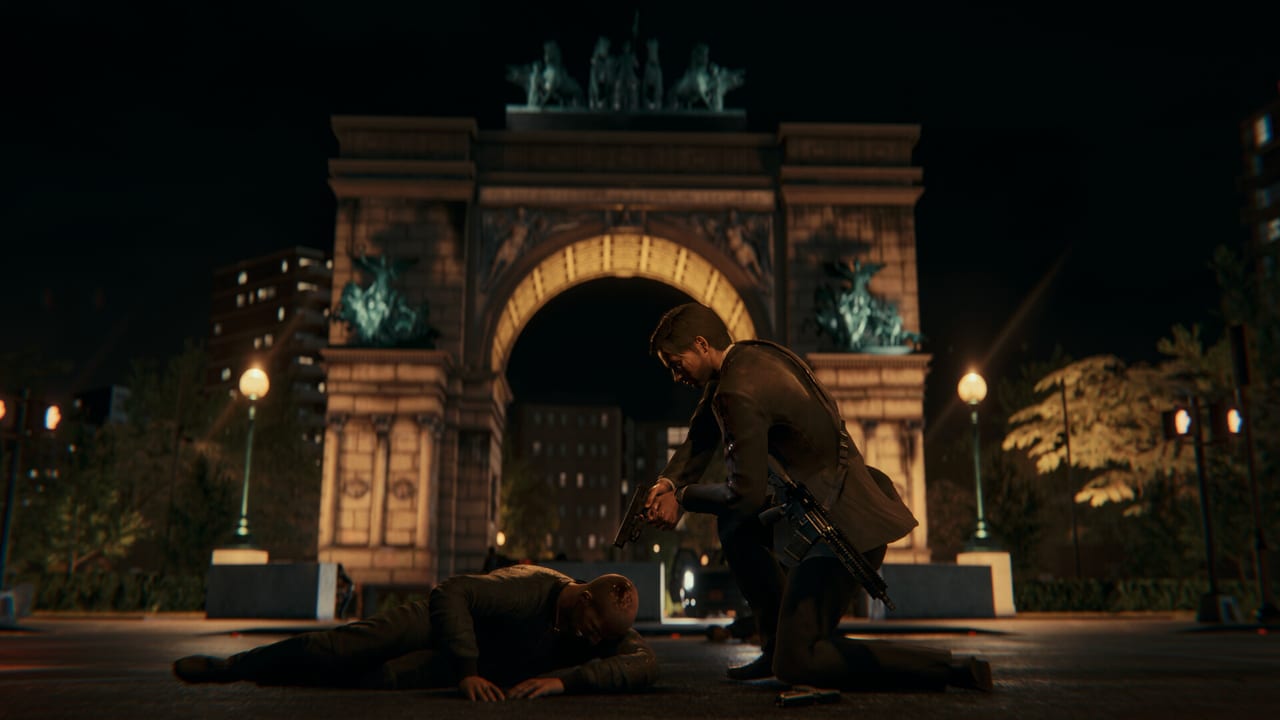
BLACKWOOD is a single-player cinematic third-person action thriller set in a reconstructed 2012 New York. This page is the layout of that city as AttritoM7 Productions has actually shown it — not a labelled atlas, and not a promise that you can tour every borough. Act 1 is still upcoming on Steam for Windows on September 16, 2026. Official copy sells authentic streets, interiors, and a Brooklyn DVD store that is also a home you decorate. It has not published a complete in-game map with named districts. Treat what follows as a model of how the city is used. Printable street indexes belong after launch, on this same URL, once they can be checked in the shipping build.
If you arrived here looking for a GTA-style free-roam sandbox, stop. The official Act 1 release announcement is explicit: BLACKWOOD is a focused linear single-player game. It is not an open-world game. The honest model is a hub plus mission slices. You live and work in the shop. Missions take Anton Blackwood into pieces of the city — on foot and driving — then send him home. That loop is the map. The Guides hub holds the rest of the how-to.
The shop is the centre, not a fast-travel icon
Steam copy is stubborn: authentic recreation of New York, 2012, and a store that is also the apartment. Brooklyn is the neighbourhood of work. You wake there, restock, change outfits, and sleep there. Store management is how the legal half of the day occupies that building. Amelie holds the counter when you leave. The space is small on purpose. It is a stage for looking ordinary, not a district select on a pause map.
Leaving the shop is a decision inside a calendar. The published day sequence is wake at home, manage the store, take a main or side mission, return and close, upgrade, then sleep. Seven days make a week. Four weeks make a month. The city does not pause while you wander for screenshots. Sleeping moves the clock that charges about 11–13k in rent and hush money. Read that clock on dual economy before you treat a pretty block as an excuse to skip the till.
Civilian clothes and civilian guns — Clean Cash purchases — are how Anton walks Brooklyn without looking like a walking armoury. Night hardware stays on Dirty Cash. The weapons hub is for those kits. The street is where the costume has to hold. A rifle that belongs in a contract does not belong in the doorway while a customer is buying a DVD.
What the prologue actually shows
The official gameplay trailer is prologue flavour, not a tour of every Act 1 block. Anton emerges from sewers after stealing a USB from a mob outfit, then fights at night near Grand Army Plaza. That is a named real-world landmark in Brooklyn. It is also a chain of spaces: underground, then street, then a fight that uses cover, dives, and contextual takedowns. Pair the clip with combat for how rooms restore health, and with controls for the verbs — aim, slide, inspect a magazine — you will use on those streets.
Grand Army Plaza is the only public landmark this wiki will treat as confirmed footage. Other neighbourhood names, subway maps, and claims that a whole borough unlocks after a set hour are unconfirmed until the shipping build is in players’ hands. Do not memorize a fan-drawn borough chart as if it were a loading screen. A cinematic set can look like a whole city and still be a handful of connected streets.
Streets, chases, and 2012 texture
Press coverage of the city stresses neon-lit streets, on-foot and driving chases, and dense world-building: ads, tattoos, posters, the 2012 clutter that dates a block without a subtitle. Those details are the point of an authentic recreation. They are not proof that you can idle from one end of New York to the other. A cinematic thriller can sell a chase across a few connected streets and still send you back to the shop.
Driving exists in the pitch. How large the drivable slices are, whether cars are mission-gated, and whether you keep a personal vehicle overnight remain unconfirmed. Until Act 1 launches, plan for missions that mix walking and driving, then a return home. Getting Started is the day list that sits under that travel.
Combat in the city is not an arena with a health crate. Corners, ledges, vehicles, and tight interiors feed takedowns. Neon and rain are lighting, not a difficulty modifier we can quote. If a creator posts a “best rooftop camp” before September 16, they are guessing. Learn movement so the first public street fight is a geometry problem, not a tourist photo.
The year is a constraint as well as flavour. DVD retail still makes sense. Phones are not 2026 phones. Posters and ads are supposed to carry story, which is why skipping every prop on a mission street is a missed brief. Read the block the way you read a contract: what is on the wall is part of 2012 New York, not wallpaper.
How a day uses the city
A useful mental map for Act 1:
- Home and shop in Brooklyn — Clean Cash, outfits, conversation, sleep.
- A mission slice — Dirty Cash, guns, a takedown in a room dressed for 2012.
- Return — close the store, spend, rest.
That is not a minimap legend. It is the only structure the studio has explained in public. Side missions can return with modifiers. Main missions can be replayed. None of those replays freeze the month. A night that prints Dirty Cash still leaves you in the same apartment that owes rent.
If your PC cannot hold a detailed street at 1080p Low, the city will not feel authentic. Confirm the published specs on system requirements — 16 GB of RAM and an SSD are on the minimum. The release date page is the stamp for when those streets become playable.
What this page will not invent
- A labelled district atlas. No complete in-game map screenshot with named neighbourhoods has been published.
- Full borough traversal. The studio has not confirmed a GTA-style free-roam open world.
- Collectible maps, fast-travel towers, or a metro you can ride for fun. Unconfirmed.
- Exact shop coordinates relative to Grand Army Plaza. Unconfirmed.
After Act 1 is live, this same URL will add observed mission districts, whether the hub has a local stroll radius, and which landmarks appear outside the trailer. Until then, use the city as Anton uses it: a place to look ordinary, a place to finish a contract, and a place you have to come back from. The map is the day loop. Everything else is still a screenshot without a legend.
Frequently Asked Questions
Quick answers to the most common questions.
Is BLACKWOOD a GTA-style free-roam open world?
No. The official release announcement says it is a focused linear campaign, not open world. Treat the Brooklyn shop as a hub and missions as city slices. See Getting Started.
Has the studio published a complete labelled map?
No. No public in-game map screenshot with named districts has been released as a full atlas. This page will add observed districts after Act 1 ships on the release date.
Where does Anton actually live and work?
A small Brooklyn DVD store that is also home you decorate. Store management and Amelie cover the daytime half of that building.
Which New York locations are confirmed before launch?
The shop-apartment hub in Brooklyn, and a night fight near Grand Army Plaza after a sewer escape in the official prologue trailer. Other named blocks remain unconfirmed. Combat in those spaces is on combat.